Car Won't Start? How to Tell If It's the Battery
Learn the sounds and signs that point to a dead battery, how to test it with a multimeter, jump-start it safely, and tell it apart from the alternator or starter.
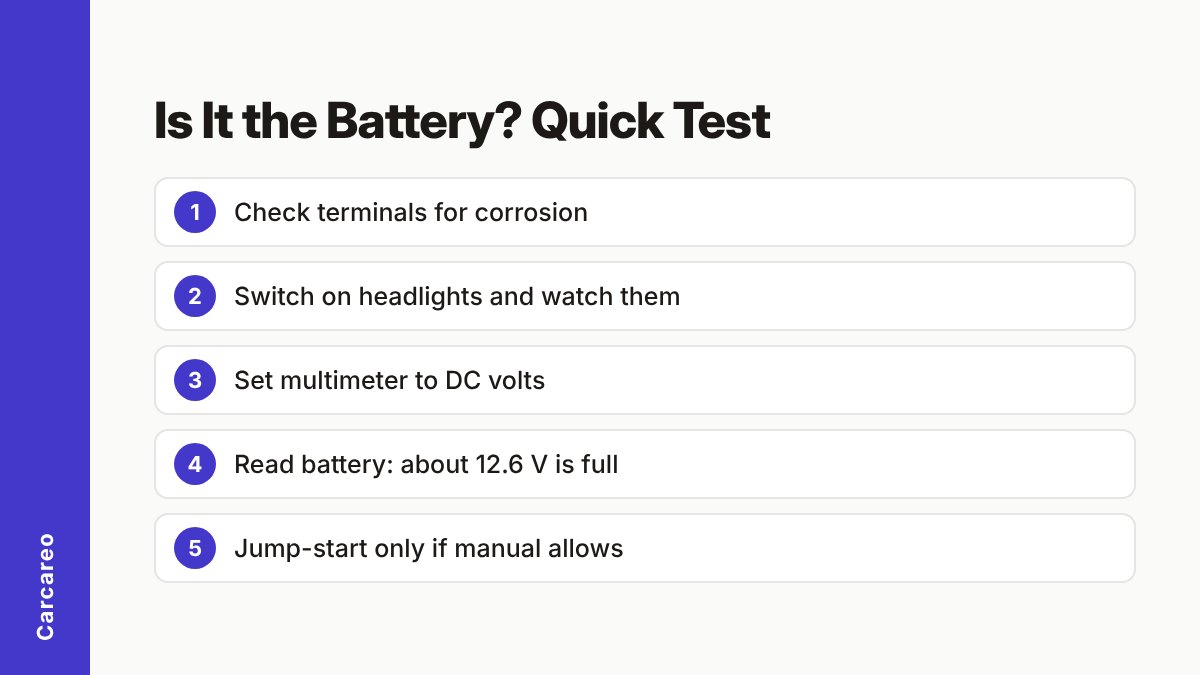
A car that will not start is usually a battery problem when the dash lights are dim or dead, the engine cranks slowly, or you hear rapid clicking. A multimeter reading of well under 12 V with the engine off confirms it. This guide shows you how to check, what to do next, and how to separate a weak battery from a failing alternator or starter.
Safety first: Read your owner’s manual before testing or jump-starting. Never work under a car supported only by a jack. If you drive an electric vehicle, the high-voltage system is for trained technicians only. This guide covers the regular 12-volt battery that most cars, hybrids and EVs also have.
Quick answer
Look at what happens when you turn the key or press the start button.
| What you see or hear | Most likely cause | Next step |
|---|---|---|
| Dash lights dim or off, nothing happens | Discharged battery or loose terminals | Check terminals, then test voltage |
| Rapid clicking | Battery too weak to turn the starter | Test voltage, try a jump-start |
| Slow, struggling crank | Weak battery, cold weather or corrosion | Test voltage, clean terminals |
| Bright lights, single click or silence | Starter, relay or connection fault | Check the manual, call a professional |
| Engine cranks normally but will not fire | Likely fuel (petrol/gas) or ignition, not the battery | See a mechanic |
| Starts after a jump, then dies later | Alternator not charging, or battery near the end of its life | Test running voltage |
Signs the battery is the problem
A weak battery tends to announce itself before it fails completely. According to a tire and auto service chain’s battery guide, common signs include slow or struggling cranking, dimming or flickering headlights and dash lights, glitchy electronics or a radio that resets, and needing frequent jump-starts.
A useful quick test is the headlights. Turn them on before you try to start the car. If they are bright and stay bright while you crank, the battery is probably holding up and you should look at the starter or other parts. If they dim sharply or go out, the battery is the stronger suspect.
Also look for the obvious: a loose cable clamp, white or blue-green crusty corrosion around the terminals, or a swollen, cracked or leaking battery case. A poor connection can mimic a dead battery, and cleaning and tightening it sometimes fixes the problem.
What you need
- A digital multimeter (any basic model that reads DC volts)
- Safety glasses and gloves
- A wire brush for terminals, if they are corroded
- Jumper cables or a portable jump starter
- Your owner’s manual, to find the battery and any jump-start points
Some cars have the battery in the trunk (boot) or under a seat, and some have dedicated jump terminals under the hood. The manual shows where.
How to test the battery with a multimeter
Lead-acid batteries contain acid and can release explosive gas, so keep sparks and flames away and wear eye protection. Turn off all accessories before you take a reading, and keep your hands clear of fans and belts if the engine is running.
- Inspect first. Look at the terminals for corrosion or looseness and check the case for damage.
- Remove surface charge. If the car was driven recently, switch the headlights on for about a minute, then off, so the reading is not artificially high.
- Set the meter. Choose DC volts. Put the black lead in the COM port and the red lead in the voltage port. Use a range that covers at least 15 V; some meters label it 6 V or 60 V, and your meter’s manual explains the options.
- Connect the leads. Touch the red lead to the positive (+) terminal and the black lead to the negative (-) terminal.
- Read the number. Compare it with the table below.
Resting voltage (engine off)
| Reading | What it suggests |
|---|---|
| About 12.6 V | Fully charged |
| About 12.4 V | Roughly 75% charged |
| About 12.2 V | Roughly 50% charged |
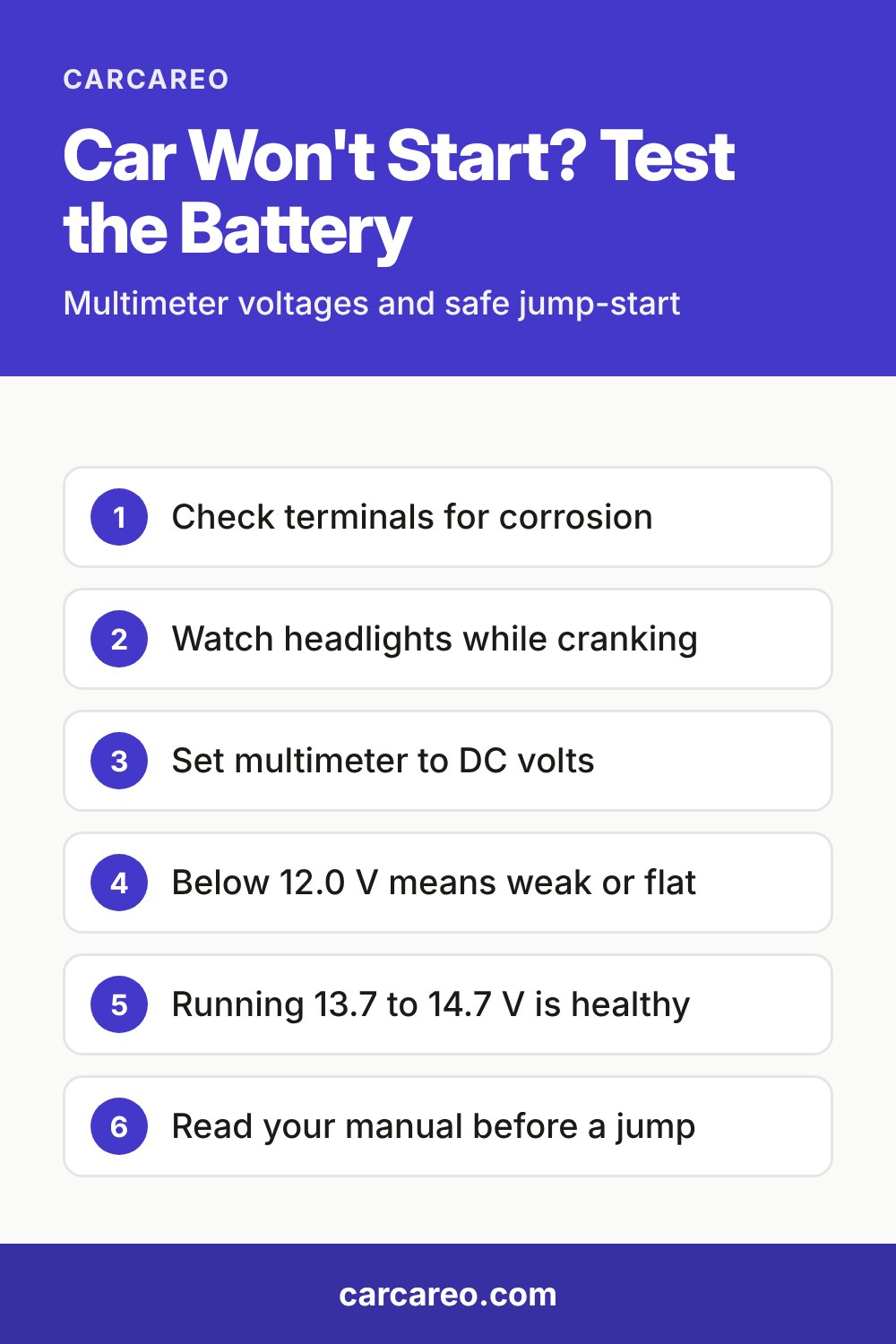
| Below 12.0 V | Discharged or weak |
These figures come from a multimeter maker’s guide. Another source describes a healthy, charged battery as sitting at roughly 12.2 to 12.6 V, so treat the numbers as a guide, not a hard line.
If the battery reads low, it may simply be drained, for example by lights left on, or it may be worn out. A jump-start or a charge followed by a retest helps you find out which. A battery that falls back to a low reading soon after being charged is a replacement candidate, and a parts or service shop can run a proper load test.
Alternator or starter? Clues and a second test
The alternator recharges the battery while the engine runs. If it fails, the battery slowly drains and eventually cannot start the car. That makes a failed alternator look like a failed battery, so test both.
With the car running (after a jump-start, if needed), measure across the battery terminals again.
| Running reading | What it suggests |
|---|---|
| Above about 13.0 V | The battery is receiving charge |
| About 13.7 to 14.7 V | Healthy alternator output |
| Below about 12 V while driving | Alternator is probably not charging properly |
| Above about 15 V | Overcharging, often a faulty regulator or alternator |
If the battery warning light stays on after the engine starts, that can point to a charging problem. Stop and get it checked rather than driving far.
Here is how the three suspects compare.
| Clue | Battery | Alternator | Starter |
|---|---|---|---|
| Lights when cranking | Dim or off | Dim, and getting worse over days | Usually bright |
| Sound | Rapid clicks or slow crank | Often fine at first, then battery goes flat | Single click, grinding or silence |
| Jump-start helps? | Yes, and it keeps running | Starts, then stalls or dies later | Usually no change |
| Resting voltage | Low | May be low after repeated drain | Normal |
| Running voltage | Normal | Outside the healthy range | Normal |
How to jump-start a car safely
Check your owner’s manual first, since some manufacturers advise against jump-starting. Do not attempt it if the battery is frozen, cracked or leaking, or if the manual says not to.
- Park the donor car close, but not touching, and turn its engine off. Switch off lights and accessories in both cars.
- Put on gloves and eye protection, and identify the positive (+, usually red) and negative (-, usually black) terminals.
- Clamp one red cable to the positive terminal of the dead battery.
- Clamp the other red cable to the positive terminal of the donor battery.
- Clamp one black cable to the negative terminal of the donor battery.
- Clamp the last black cable to unpainted metal on the dead car’s engine block, away from the battery. This final connection can spark, which is why it goes on bare metal and not the battery.
- Start the donor car and let it run a few minutes, then try the dead car. If it does not start, wait a few more minutes and try again.
- Once it starts, let it run for a few minutes before removing the clamps in the reverse order. Never let the clamps touch each other while connected.
- Drive for around 30 minutes so the battery can recharge, then retest the voltage.
If the car still will not start after several attempts, stop and call for help.
Common mistakes
- Assuming it is always the battery. A good battery can still leave you stuck if the starter, alternator, or a fuel or ignition part has failed.
- Skipping the terminals. Loose or corroded clamps can stop a healthy battery from delivering power. Clean corrosion with a wire brush, not bare hands, and avoid breathing the dust.
- Mixing up the cable order. Connecting the last black clamp to the dead battery instead of bare metal raises the chance of a spark near battery gas.
- Letting clamps touch. Once the cables are live, keep the metal ends apart.
- Reading voltage right after driving. Surface charge can show a falsely healthy number. Switch the headlights on briefly first.
- Repeated jump-starting. Needing a jump again and again points to a failing battery or charging fault, not bad luck.
When to call a professional
Get help if any of these apply:
- The battery case is cracked, leaking, swollen or frozen.
- The car cranks normally but will not start, which suggests a fuel or ignition fault.
- You hear a single click or grinding with bright lights, which points toward the starter.
- The battery light stays on after the engine starts.
- The car will not start after several jump-start attempts.
- You drive an EV or hybrid and see high-voltage warnings. Do not open or touch orange high-voltage cables or components.
- You are unsure where to safely lift, support or reach anything. Never rely on a jack alone to hold a car while you work underneath.
Quick prevention checklist
- Have the battery tested if it struggles in cold weather or is several years old.
- Keep terminals clean and tight.
- Switch off lights and accessories before leaving the car.
- Take longer drives now and then so the alternator can recharge the battery.
- Keep a set of jumper cables or a jump starter in the car, and know where your manual says to connect them.
Sources
Frequently asked questions
How can I tell if it's the battery or the starter?
A battery problem usually shows up as dim lights, a rapid clicking, or slow cranking. If the lights stay bright but you hear a single click or nothing when you turn the key, the starter (or its connection) becomes more likely. A voltage reading settles it.
What voltage means a dead car battery?
With the engine off, about 12.6 V is fully charged and a reading below about 12.0 V points to a discharged or weak battery. Check your meter reading against the table in this guide.
Can a bad alternator stop my car from starting?
Yes, indirectly. If the alternator is not recharging the battery while you drive, the battery runs down until there is not enough power to crank the engine. A running-voltage test helps you spot this.
Should I jump-start my car if I'm not sure what's wrong?
Only after checking your owner's manual, because some manufacturers advise against it, and only if the battery is not cracked, leaking or frozen. If the car still will not start after a few tries, stop and call for help.